BARIS CAYLI MESSINA
BOOKS

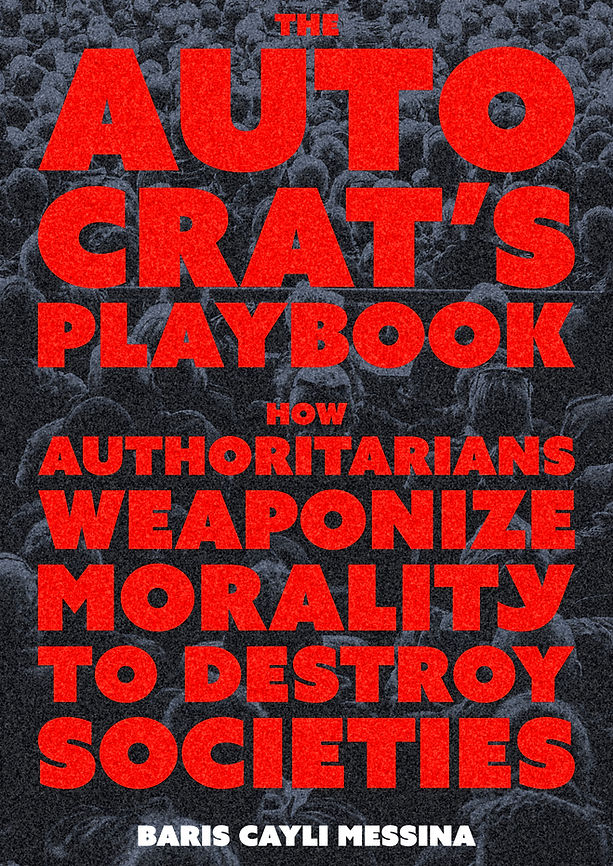
THE AUTOCRAT'S PLAYBOOK:
HOW AUTHORITARIANS WEAPONIZE MORALITY TO DESTROY SOCIETIES
Forthcoming from the University of California Press, March 2027
"A powerful account of how authoritarian leaders make cruelty, exclusion, and repression appear morally justified."
Across democracies and autocracies alike, a growing form of authoritarian control uses moral slogans and patriotic scripts to quash dissent. These leaders increasingly justify repression in moral defense of families, children, values, or the nation itself.
In The Autocrat’s Playbook, Baris Cayli Messina introduces the “moral trap,” a novel framework that reveals how authoritarian regimes around the world use morality to create fear, stigmatize activists, criminalize dissent, and ultimately isolate people from one another. Drawing on historical and contemporary cases ranging from Nazi Germany and Maoist China to apartheid South Africa, Putin’s Russia, and the Trump-era United States and beyond, Messina shows how autocrats consolidate their power and manufacture obedience by reshaping what people believe is right, normal, and worthy.
Timely and provocative, The Autocrat’s Playbook offers a bold new way of understanding how social and political repression works and how collective resistance survives
REVIEWS
THE AUTOCRAT'S PLAYBOOK
DIDIER FASSIN
Professor of Sociology and Anthropology
Collège de France
Author of Humanitarian Reason
To silence and repress dissenters and the righteous, autocrats implacably invert the ethical order, making truth a lie and virtue a crime. This is superbly and frighteningly exposed in The Autocrat’s Playbook through harrowing cases across the contemporary Orwellian world we inhabit. A much-needed study of authoritarianism
RUTH BEN-GHIAT
Professor of History and Italian, NYU
Author of Strongmen: Mussolini to the Present
A clearly written and absorbing study of how autocrats appropriate the language of morality to divide societies. It has never been more important to understand how they create fear and stigmatize, criminalize, and isolate their enemies.
FEDERICO FINCHELSTEIN
Professor of History
The New School, Author of
Wannabe Fascists
In The Autocrat’s Playbook, Professor Baris Cayli Messina shows us how antidemocratic logic operates under the disguise of virtuosity. This authoritarian camouflage convinces many people of the need for violence, repression, occlusion and isolation. Messina invites us to think further, beyond current explanations of the ongoing attacks against democracy.
DAVID
CUNNINGHAM
Professor of Sociology
Washington University in St. Louis, author of
There's Something Happening Here
The Autocrat’s Playbook compellingly demonstrates that political domination isn’t only, or even predominantly, realized through force and repression. Rather, autocrats exert their hold through more insidious moral traps that demonize and isolate populations. By presciently exposing architectures of domination and then furnishing crucial insight into strategies of resistance that have undermined such systems, Messina offers a powerful gift: our counter-playbook for alarmingly autocratic times.


A SLOW REVOLUTION:
THE BETRAYAL OF SICILIANS AND THEIR WAR ON THE MAFIA
Forthcoming from Cornell University Press, February 2027
"A sweeping account of Sicily’s generations-long struggle against the mafia. A rare look at why some revolutions span centuries—and the human cost of that relentless fight."
A Slow Revolution immerses readers in Sicily’s enduring fight against the mafia; a battle that has spanned more than 150 years. It responds to a critical and urgent question: Why do some revolutions unfold so slowly, stretching across generations with a heavy toll of suffering?
Drawing on extensive archival documents and over a decade of ethnographic research, the book brings new insights into the human and temporal dimensions of this ongoing revolution. It reveals how resistance is shaped through collective suffering, multi-generational trauma, and a sustainable movement that transforms Sicily’s fight against the mafia into a painfully slow process.
A Slow Revolution is rooted in Sicily’s turbulent history and offers universal lessons on the pace of social change and the transformation of social norms. This is an essential text to understand how collective resistance becomes sustainable and why it has to face grim challenges in the face of an unreliable state and oppressive non-state authorities.
The book sheds new light on the catastrophic consequences of revolutionary attempts to oppose entrenched power systems and illustrates how these consequences are transformed into the weapons of slow revolutions.
REVIEWS
A SLOW REVOLUTION
FEDERICO VARESE
PROFESSOR OF SOCIOLOGY
SCIENCES PO/UNIVERSITY OF OXFORD
Messina has a prominent voice and a strong, provocative stance in this area. The focus of A Slow Revolution on collective action in a context where mafia power is deeply embedded in society, extending well beyond formal institutions, will have a substantial impact.
LUCY RIALL
PROFESSOR OF HISTORY,
EUROPEAN UNIVERSITY INSTITUTE
This is a remarkable history of popular resistance. With compelling detail, Messina explains why this story should be of interest to us all.
GIOVANNA SUMMERFIELD
CASTANOLI ENDOWED PROFESSOR OF ITALIAN AND FRENCH
AUBURN UNIVERSITY
A Slow Revolution is a significant accomplishment. Baris Cayli Messina provides great examples for unfamiliar readers alongside reflections for the readers who are familiar.


QUEER UNDER SIEGE:
HOW GLOBAL REPRESSION WORKS AND HOW WE RESIST
Forthcoming from Temple University Press, May 2027
"The first book to expose the global war on queer life as a unified system of repression, tracing how societies cast queer people out, punish them, and erase them from public memory, while bearing witness to the queer rebellions that have refused to surrender from the 1950s to the present."
Queer Under Siege reveals that collective repression is not only a global system, but a moral process that shapes how people tolerate, and sometimes justify, exclusion and oppression. Baris Cayli Messina asks the disturbing question: What kind of society sustains its morality by expelling those who are already most vulnerable? He examines why societies generate the conditions that produce repression, forcing queer people to struggle for survival.
Cayli Messina draws on archives, court records, suicide letters, and activist testimony worldwide to develop a conceptual framework to trace this process through three interlocking mechanisms: moral eviction, which defines moral repression; punitive hypervisibility, which animates political repression; and sanctioned oblivion, which consolidates epistemic repression.
Queer Under Siege shows that the criminalization of queer life is not a misfire, but a systematic means of producing an imagined sense of moral and social order. Repression works by marking some lives as dangerous, exposing them to punishment, and then pushing their experiences beyond public recognition. Queer Under Siege is also about resistance. Arguing that survival itself can become a political act, Cayli Messina traces how queer people across borders and generations have challenged repression, preserved memory, built solidarities, and created new possibilities for collective life.

"The first comprehensive analysis of the use of violence by militant groups across time and space."
How do militants rationalize violence and what are their motives? How do time and space shape their destiny? In Violence and Militants Baris Cayli explores these enduring questions by comparing violent episodes in towns and villages in the nineteenth-century Ottoman Balkans with today's zones of conflict from Afghanistan to the Middle East.
Placing history alongside the troubles of the present, Violence and Militants compares Christian militants who rebelled against the Ottoman Empire and four jihadist organizations of today: Hezbollah, Hamas, al-Qaeda, and Isis. Drawing on scholarship by political theorists, historians, sociologists, anthropologists, and philosophers, Cayli traces the root of dissent to a perceived deprivation that leads to aggressive protest and action. He argues that the rationalization of violence functions independently of time and geographical location, while politico-religious and socio-structural factors determine the scope of violence. Through a riveting narrative, this book uncovers how militant groups use revenge, ideals, and confrontation to generate fear and terror in the name of justice.
Breaking new ground, Violence and Militants is the first book to address this complex relationship across different periods of history.